Wednesday, December 12, 2012


Monday, October 29, 2012
Susan Sharpe’s Tips for Helping your Dog “Weather” Hurricane Sandy
1. Breathe.

2. Secure.
ID your pets. Be sure your pets have ID on their collars and that it’s readable. Oils from their coats can erase information more quickly than you think. Double check their collars are securely fastened.
Use crates/carriers. Cats should be in their carriers/crates. If you’re concerned you may need to evacuate the house quickly, put your cat(s) in the carrier before the storm approaches. That way you can easily grab and go if needed. Your dog should feel secure in his/her crate. You may want to move the crate to be in the same room you are during the storm to help your dog be more comfortable. If he/she is showing signs of stress, cover the crate with blankets but allow fresh air to circulate. Provide peanut-butter-stuffed toys or other toys/treats that will occupy him/her.
3. Storm Anxiety.
Wrap Him. Use Anxiety Wrap, Quiet Dog, or any other tool you have that helps relax your dog at the first sign of storm anxiety. As usual, once you apply Anxiety Wrap or Quiet Dog, don’t interact with your dog. Remain calm and neutral otherwise you may risk increasing your dog’s anxiety level. If your dog begins to run anxiously throughout the house, crate him or tether him with a leash to a fixed object where he feels protected to avoid having his adrenaline level rise further. Some dogs are task-oriented and may fare better if leashed and walked through the house practicing commands. Use the house like an obstacle course and give lots of juicy treats as you go. If your dog prefers a dark closet, allow him/her to use it as a safe place as long as he’s not being destructive. You know your dog best and know which approach is best.
Other Tips. If you have electricity: a) gently place cotton ball in each ear to muffle the storm sounds; and b) turn on the TV/radio/van/dryer/washing machine to muffle the storm sounds and provide a familiar one to help comfort them.
If lightning/thundering: dampen Anxiety Wrap to prevent static charges from scaring the dog; close the window curtains and also turn on outside and inside lights to help mask the lightning flashes.
4. Travel Anxiety.
Calm and Contain. Use Anxiety Wrap, Quiet Dog, or any tool you have to help relax your dog. You want to associate any change/new thing to = “I get yummy treats!” in your dog’s mind. You can always cut back on your dog’s daily food ration to make up for the extra treats. If you’re temporarily staying in a different environment, give your dog time to adjust in a quiet spot if possible. If your dog is fearful by nature, now’s not the time to try to socialize him/her. Provide plenty of “safe space” and avoid having people approach him/her.
If you are getting separated from your pets, provide them with blankets/clothing with your scent on it and their favorite toy to help ease the time away.
www.anxietywrap.com • 877-652-1266
Tuesday, April 10, 2012
Dog Anxiety Wrap Helps Thunder, Storm & Lightning Fear
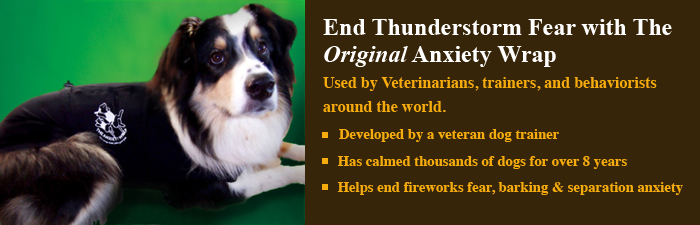
Is your dog afraid of thunderstorms, lightning or heavy rains? The Anxiety Wrap often allows an animal to sleep through a storm. This form fitting wrap for dogs helps alleviate the fear a dog may have of the loud noises that accompanying thunderstorms. We had great success using the Anxiety Wrap with our own dog Daisy. The following article outlines how and why the Anxiety Wrap could work to make those thunderstorms a little more bearable for your dog.
Anxiety Wrap: Helping to Improve the Lives of Dogs
By Susan Sharpe Creator of the Anxiety Wrap
Thunderstorms – are they causing your dog fear, stress, pacing, anxiety, panting or nervousness? Often using an Anxiety Wrap will allow him or her to sleep right through the storm. Many people have noticed much improvement within 1 to 3 times of using the Anxiety Wrap.
 The Anxiety Wrap was created to fill an existing need, an alternative or holistic approach to behavior modification for dogs. It can happen by using the Anxiety Wrap to ease your dog's anxieties. When used properly it has proven positive to increase balance, self-confidence, focus, preparation for and during training, animal to animal socialization, animal to human socialization, bonding, relaxation, and gait awareness. As well as helping to end dog aggression, shyness, nervousness, releasing stress & tension, end jumping, stop destructive chewing, fear biting, car sickness, unnecessary barking, shyness, fear of loud noises, thunderstorm fear, sensitivity to touch, sensitive to sound, aloofness, emotional upset, hyperactivity, grooming issues and other anxieties.
Dogs, Like People, Are Individuals
Conventional medicine, behaviorists and trainers all have their place and the Anxiety Wrap was not designed nor intended to replace any of them, but rather to be an alternative or holistic addition to the plan. Being a trainer myself, I know from personal experience that animals, like people, are individuals. Both often require different ways of learning and/or recovery for past experiences.
Far too often animals, like people, fall through the cracks when traditional methods fail. Anyone wishing to see some of these animals need go no further than your local animal shelter or even your own neighborhood. When I personally experienced that traditional training didn’t work with one of my own dogs, it was then I began my search for alternative ways of training. A way of working with the entire animal that would include their mind, body and spirit.
This search led me from traditional training, that focuses on punishment for offering a wrong behavior and the removal of that punishment for offering the one desired, to a kinder, more respectful way of training. I was searching for a way to teach that could be fun for both animal and human. Soon I was using two reward methods of training. Operant Conditioning combined with Clicker Training but still there was more to be learned.
Our "Throw Away" Dogs
What about the dogs that didn’t or couldn’t respond to reward training alone? Those animals whose past issues and present fears were so overwhelming, it left them powerless to focus on anything else. Often these are the dogs we see abandoned, passed from one home to another. Dogs excessively crated, kenneled or chained, isolated with little hope of ever truly becoming part of a family pack.
Changing Dog Behavior By Changing The Body's Sensations
Soon I found myself studying the latest beliefs in calming signals and animal behavior. I became a Tellington Touch Practitioner, successfully completed Purdue University's "DOGS" Course Principles and Behavior, Bailey's Clicker Training, and the list goes on. After these workshops, seminars, clinics and courses I came to learn many behaviors and some health issues could be affected by the manipulation of the skin and by applying light to moderate pressure to certain areas of the body.
Behavior modification, a more rapid recovery -- they appeared to be aided by these sensations. But why? Why did it have an effect?
All my years of traditionalism prevented me from accepting what I had witnessed. Then I read a book titled Molecules Of Emotion by Candace B. Pert, PhD. When Candace wrote "the body and mind are not separate and one cannot be treated without the other," the pieces of the puzzle started coming together. Added to that learning was the example of Temple Grandin's "Hug Box," a device developed to apply deep pressure to help calm autistic children's over stimulated nerves. So we envisioned a product that would cover a large portion of an animal’s body without falling off or allowing the animal to get tangled up in it. At the same time it could not be binding or distracting, so to help calm the animal and help modify the undesirable behaviors.
I realized that animals, though admittedly much different than humans, still possess some of the same physiological and, may we dare suggest, some of the same psychological make up. Finally I began to understand how these effects were being possible.
Realizing this I began to experiment using various types of materials put together in various ways to increase the positive effects of the sensations being sent to the animal's brain by use of the body's receptors. Opening up the neurological pathways and substituting new sensations for old habitual ones.
Over much time and many prototypes the Anxiety Wrap was developed. A Wrap especially designed to help your animal as well as my own and those of my clients. Shereen Faber, PH.D., OTR, FAOTA, and author of Neurorehabilitation A Multisensory Approach, contacted us after discovering our product. She explains how The Anxiety Wrap uses a Technique called "Maintained Pressure" to help calm the sensory receptors.
We've found The Anxiety Wrap works especially well in situations where your dog is anxious or fearful, whether it's during a thunderstorm or trips to the vet or meeting new people. Due to its ability to help an animal become more focused, the Anxiety Wrap is an excellent tool for use with gentle training methods.
It can provide an under-confident animal with a greater sense of security, helping it become more comfortable and begin increasing confidence. For overly excited or hyper dogs, the Anxiety Wrap can help an animal become more calm and relaxed. Remember that every animal is unique and there are countless other ways the Anxiety Wrap can improve your dog’s quality of life.
Anxiety Wrap: Helping to Improve the Lives of Dogs
By Susan Sharpe Creator of the Anxiety Wrap
Thunderstorms – are they causing your dog fear, stress, pacing, anxiety, panting or nervousness? Often using an Anxiety Wrap will allow him or her to sleep right through the storm. Many people have noticed much improvement within 1 to 3 times of using the Anxiety Wrap.
Dogs, Like People, Are Individuals
Conventional medicine, behaviorists and trainers all have their place and the Anxiety Wrap was not designed nor intended to replace any of them, but rather to be an alternative or holistic addition to the plan. Being a trainer myself, I know from personal experience that animals, like people, are individuals. Both often require different ways of learning and/or recovery for past experiences.
Far too often animals, like people, fall through the cracks when traditional methods fail. Anyone wishing to see some of these animals need go no further than your local animal shelter or even your own neighborhood. When I personally experienced that traditional training didn’t work with one of my own dogs, it was then I began my search for alternative ways of training. A way of working with the entire animal that would include their mind, body and spirit.
This search led me from traditional training, that focuses on punishment for offering a wrong behavior and the removal of that punishment for offering the one desired, to a kinder, more respectful way of training. I was searching for a way to teach that could be fun for both animal and human. Soon I was using two reward methods of training. Operant Conditioning combined with Clicker Training but still there was more to be learned.
Our "Throw Away" Dogs
What about the dogs that didn’t or couldn’t respond to reward training alone? Those animals whose past issues and present fears were so overwhelming, it left them powerless to focus on anything else. Often these are the dogs we see abandoned, passed from one home to another. Dogs excessively crated, kenneled or chained, isolated with little hope of ever truly becoming part of a family pack.
Changing Dog Behavior By Changing The Body's Sensations
Soon I found myself studying the latest beliefs in calming signals and animal behavior. I became a Tellington Touch Practitioner, successfully completed Purdue University's "DOGS" Course Principles and Behavior, Bailey's Clicker Training, and the list goes on. After these workshops, seminars, clinics and courses I came to learn many behaviors and some health issues could be affected by the manipulation of the skin and by applying light to moderate pressure to certain areas of the body.
Behavior modification, a more rapid recovery -- they appeared to be aided by these sensations. But why? Why did it have an effect?
All my years of traditionalism prevented me from accepting what I had witnessed. Then I read a book titled Molecules Of Emotion by Candace B. Pert, PhD. When Candace wrote "the body and mind are not separate and one cannot be treated without the other," the pieces of the puzzle started coming together. Added to that learning was the example of Temple Grandin's "Hug Box," a device developed to apply deep pressure to help calm autistic children's over stimulated nerves. So we envisioned a product that would cover a large portion of an animal’s body without falling off or allowing the animal to get tangled up in it. At the same time it could not be binding or distracting, so to help calm the animal and help modify the undesirable behaviors.
I realized that animals, though admittedly much different than humans, still possess some of the same physiological and, may we dare suggest, some of the same psychological make up. Finally I began to understand how these effects were being possible.
Realizing this I began to experiment using various types of materials put together in various ways to increase the positive effects of the sensations being sent to the animal's brain by use of the body's receptors. Opening up the neurological pathways and substituting new sensations for old habitual ones.
Over much time and many prototypes the Anxiety Wrap was developed. A Wrap especially designed to help your animal as well as my own and those of my clients. Shereen Faber, PH.D., OTR, FAOTA, and author of Neurorehabilitation A Multisensory Approach, contacted us after discovering our product. She explains how The Anxiety Wrap uses a Technique called "Maintained Pressure" to help calm the sensory receptors.
We've found The Anxiety Wrap works especially well in situations where your dog is anxious or fearful, whether it's during a thunderstorm or trips to the vet or meeting new people. Due to its ability to help an animal become more focused, the Anxiety Wrap is an excellent tool for use with gentle training methods.
It can provide an under-confident animal with a greater sense of security, helping it become more comfortable and begin increasing confidence. For overly excited or hyper dogs, the Anxiety Wrap can help an animal become more calm and relaxed. Remember that every animal is unique and there are countless other ways the Anxiety Wrap can improve your dog’s quality of life.
Friday, February 24, 2012
Comparison of Anxiety Wrap, Thundershirt & Storm Defender
Comparison of Anxiety Wrap, Thundershirt & Storm Defender
By Cindy Ludwig, M.A., KPA-CTP Introduction
How does The original Anxiety Wrap Compare to the Thundershirt & Storm Defender? Each of these products is recommended for Thunderstorm phobia in dogs, but are they all equally effective? Are there any research studies to corroborate the claims of effectiveness of these products?
Features
The Anxiety Wrap

The original patented pressure wrap, the Anxiety Wrap was developed by Susan Sharpe, a certified professional dog trainer and T-touch practitioner in 2001.
The Anxiety Wrap works in two ways: 1) maintained pressure, and 2) pressure applied to acupressure points in the neck, chest, shoulders, belly, mid-section and rear legs. Only the Anxiety Wrap has rear leg straps that create rear-end awareness to target pressure points in the hindquarters where dogs often hold tension. The straps are adjustable and removable.
The Anxiety Wrap is made of a stretchy, thin, breathable fabric. It contains elasticized elements which apply pressure to acupressure points and allow the fit to be customized to each individual dog. Velcro closures are located on the aspect of the garment that lies over the dog's back.
The Thundershirt

The Thundershirt, a pressure wrap first marketed in 2009 was developed by dog owner, Phil Blizzard. It is made of a thicker fabric than the Anxiety Wrap, with velcro closures on the front of the garment over the dog's chest as well as around the girth. The velcro near the dog's head is a drawback for sound sensitive dogs. The Thundershirt, which resembles a dog coat covers less of the chest and shoulders, especially in larger dogs, and is less form-fitting than the Anxiety Wrap.
The Storm Defender

The Storm Defender was invented by electrical engineer, Tom Critzer who first started selling the product in 2004. According to Andrew Critzer, Tom Critzer's son and Managing Member of the Storm Defender LLC, the Storm Defender is a unique product designed to alleviate Thunderstorm phobia. The product, described as a "cape," contains an anti-static metallic lining that protects the dog wearing the cape from static electricity that occurs before and during thunderstorms.
Although the Storm Defender is not a pressure wrap and is designed primarily as a treatment for Thunderstorm phobia, the Storm Defender website advises against putting the Storm Defender on a dog for separation anxiety and then leaving. Conversely, the Anxiety Wrap is a pressure wrap that is marketed for thunderstorm phobia as well as other types of anxiety. On the Anxiety Wrap website the product is advertised as safe to leave on a dog while the owner is absent. This is an important consideration for owners that have to leave to go to work.
Role of Medication
According to the Storm Defender website, "certain drugs may make the learning process [associated with use of the Storm Defender] more difficult."
When asked about this recommendation, Critzer said, "The recommendations regarding drug use mainly come from my father’s ideas about the dogs learning behaviors. We’ve softened that idea somewhat and now recommend owners consult their vets. Generally speaking, it’s difficult for dogs to sense the true effects of the Storm Defender if they are too doped up.Other than that it’s OK to combine techniques."
The Thundershirt website advertises that there is "no need for medication." On the Research page of the Thundershirt website there is a discussion of the author's opinion regarding drawbacks associated with medication, one being a long onset of action and another, oversedation. Valium is cited as an example of a drug that might be prescribed. A discussion of medication management is beyond the scope of this article but suffice it to say that Valium is not a medication used for anxiety management in dogs. In fact, it is infrequently prescribed for people these days due to the availability of shorter-acting benzodiazepines. The author writes that Fluoxetine (Prozac) is a drug that is administered for the life of the dog, but this is not usually the case.
Medication that is used to treat anxiety is usually prescribed for short term management, as it is in people, to decrease anxiety enough to allow the dog to learn to have a neutral or even positive association with an object or situation that previously evoked fear or anxiety. When medication is used it should always be accompanied by behavior modification under the guidance of a skilled professional trainer or certified behaviorist. Medication alone does not address the underlying issue or work to teach the dog new ways of responding to his environment.
The Anxiety Wrap can be used effectively alone or as an adjunct in the management of anxiety and fear. The Anxiety Wrap website does not advertise that the Anxiety Wrap eliminates the need for medication.
Cost and Guarantee
All three products offer a money-back guarantee. This excludes embroidered Thundershirt products. The Anxiety Wrap and the Thundershirt each sell for $39.95, while the Storm Defender sells for $44.99 - $55.99, depending on size. The Storm Defender can be customized with the dog's name for an additional $7.00. The Thundershirt also offers customized embroidery for an additional $10.00.
Shipping for the Storm Defender is $6.00 within the United States and $15.00 for international shipping. Shipping for the Anxiety Wrap is $6.95 for First Class Mail and International first class to Canada, $8.95 and up. Additional shipping options are available for the Anxiety Wrap. The Thundershirt is currently offering free shipping.

Sizes and Colors
The Storm Defender and Thundershirt each come in 7 different sizes, and the Anxiety Wrap is available in 11 different sizes and can also be custom-sized for an additional $25.00. . The Storm Defender is only available in red and the Anxiety Wrap is presently only available in black. The Thundershirt comes in three colors - navy blue, pink and gray.
Research
In a recent, as of yet unpublished clinical research study conducted at the Tufts Cummings School of Veterinary Medicine by Nicole Cottam and Dr. Nicholas Dodman the Anxiety Wrap was found to be effective in 89% of the study participants suffering from Thunderstorm phobia.
Based on surveys of Thundershirt customers, the company reports that "over 80% of dogs show a significant improvement in symptoms when wearing the Thundershirt." Symptoms are subjective, whereas signs are objective observations. It is impossible to evaluate symptoms in dogs since dogs do not have verbal language.
Storm Defender LLC advertises that over 95% of their customers report successful results. This statistic, according to Critzer is inferred from the number of returns which he says ranges between 2-3% of total sales.
In a study to evaluate the effectiveness of the Storm Defender Nicole Cottam and Dr. Nicholas Dodman at Tufts University divided 23 dogs into two groups, one with the anti-static Storm Defender cape and the other, a control group with a non-anti-static cape. Both capes resulted in a significant reduction in owner-reported anxiety scores from baseline scores.
Although there was a greater reduction in median anxiety score in the Storm Defender group than the group wearing the non-anti-static cape during the fourth thunderstorm, there was no statistically significant difference between the two groups in their median anxiety scores or owner assessment of anxiety reduction achieved with the cape.
The results of this study suggest is that the anti-static property of the Storm Defender may not be responsible for the product's therapeutic effect. The investigators concluded that more research is needed to determine why both capes were effective.

Summary and Conclusion
The original patented Anxiety Wrap is made of a lightweight breathable fabric that can be worn swimming and used to cool a dog in warmer months. The velcro closures are at the top of the garment away from the dog's head so that removing the garment does not startle the dog like removal of the Thundershirt.
The Anxiety Wrap comes in 11 different sizes with the option of custom sizing. It has elasticized elements to provide optimal fit, whereas the Storm Defender and the Thundershirt each come in only 7 different sizes.
The Anxiety Wrap is the only product that provides rear-end awareness for additional stress release its the adjustable and removal hind end straps.
While the Thundershirt provides pressure around the dog's girth, the Anxiety Wrap covers more body surface area and provides a more even fit with more maintained pressure than any other product on the market today.
The Storm Defender is more expensive than the Anxiety Wrap and the Thundershirt and its purported benefit is limited to thunderstorm phobia, whereas the pressure wraps are effective for all types of anxiety. The purported anti-static mechanism of the Storm Defender for anxiety reduction in thunderstorm phobia has not been substantiated by clinical research.
The Anxiety Wrap is the original pressure wrap; the Anxiety Wrap and the Storm Defender are patented, whereas the Thundershirt is not.
In a recent clinical research study conducted at Tufts University the Anxiety Wrap was determined to be a "safe and effective treatment for canine Thunderstorm phobia" with an 89% rate of effectiveness. The Storm Defender was found to be "moderately therapeutic in treating canine thunderstorm phobia," but again, the researchers were unable to conclude that this effect was due to the Storm Defender's special metallic lining.
The 95% success rate reported by Storm Defender LLC is based on the number of returned capes, and the 80% success rate advertised by the developer of the Thundershirt is based on customer surveys.
The Anxiety Wrap comes with the added bonus of online support from certified professional dog trainers at no extra charge. For the money, the original patented Anxiety Wrap offers an overall greater therapeutic benefit to dogs with Thunderstorm phobia and other anxiety-related disorders as well as the added value of customer support from experienced certified professional dog trainers.
The Thundershirt in Navy Blue
The Anxiety Wrap on an Anxious Dog
Tuesday, November 15, 2011
How a Puppy Learns
How a Puppy Learns
Classical Conditioning:
Operant Conditioning:
Puppies also learn without our input. This means fair boundaries need to be set when your puppy is still young and cute. Doing so allows your puppy to learn what normal is and how pleasant things can be when he repeats wanted behaviors. When a puppy is small and cute things he does may not bother you, but those same things will be repeated when he is older and most likely will bother you then. The lesson to be learned is; what you want your puppy to do as an adult dog is what you patiently teach him to do as a puppy.
The 4-possibilities
Positive Reinforcement (R+)
This involves giving the dog something he wants when the requested behavior is performed. EX: You say “sit” and the dog sits & receives a treat. This serves to increase the likelihood of the dog sitting in the future.
Negative Reinforcement (R-)
This involves the removal of something the dog doesn’t like when the requested behavior is performed. EX: You say “sit” the dog sits & pressure is removed from his hips. This also serves to increase the likelihood of the behavior being offered in the future.
Positive Punishment (P+)
This involves giving the dog something he does not like when the requested behavior is not performed. EX: You say “sit” and the dog lies down instead. The dog is pulled up by his collar until he sits. This is likely to decrease the down behavior, leaving only the sit, in the future.
Negative Punishment (P-)
This involves the removal of something the dog likes when he does not perform the requested behavior. EX: You ask the dog to sit, the dog lies down. You eat the treat that he was hoping to get. This is likely to decrease the down behavior, leaving only the sit, in the future.
Examples of Positive Reinforcement (R+)
*Regardless of what you want or intend to teach your dog, you are strengthening all 3 of the above behaviors.
Examples of Negative Reinforcement (R-)
*This course does not promote the use of intimidation nor physical punishment, but uses these as examples of negative reinforcement, (R-).
Examples of Positive Punishment (P+)
Examples of Negative Punishment (P-)
Regardless of what you want or intend to teach your dog, you are decreasing the likelihood of the dog failing to sit, jumping and playing too rough.
The 4-Stages of Learning
*Canine Companion, October 2009
- Simply put, all canines are born with instinct to survive -- such as having razor sharp teeth to compensate for underdeveloped jaw muscle.
- In addition to their instincts they learn from classical and operant conditioning.
Classical Conditioning:
- This means they learn to associate one thing with another.
- An example would be, the dog hears the can opener start and runs to the kitchen because past history has proven he is about to receive a can of dog food. The dog has come to learn one thing equals another.
- Dog learns when the sound of the garage door goes up, it is followed by you entering the house.
- This means the dog comes to learn one thing is the predictor that something else is likely to occur. Your dog comes to learn “what he does” has consequences.
- Example: Dog runs and jumps on a trash can, paws at it until it falls over and chews on all that great stuff that tumbles out!
Puppies also learn without our input. This means fair boundaries need to be set when your puppy is still young and cute. Doing so allows your puppy to learn what normal is and how pleasant things can be when he repeats wanted behaviors. When a puppy is small and cute things he does may not bother you, but those same things will be repeated when he is older and most likely will bother you then. The lesson to be learned is; what you want your puppy to do as an adult dog is what you patiently teach him to do as a puppy.
The 4-possibilities
Positive Reinforcement (R+)
This involves giving the dog something he wants when the requested behavior is performed. EX: You say “sit” and the dog sits & receives a treat. This serves to increase the likelihood of the dog sitting in the future.
Negative Reinforcement (R-)
This involves the removal of something the dog doesn’t like when the requested behavior is performed. EX: You say “sit” the dog sits & pressure is removed from his hips. This also serves to increase the likelihood of the behavior being offered in the future.
Positive Punishment (P+)
This involves giving the dog something he does not like when the requested behavior is not performed. EX: You say “sit” and the dog lies down instead. The dog is pulled up by his collar until he sits. This is likely to decrease the down behavior, leaving only the sit, in the future.
Negative Punishment (P-)
This involves the removal of something the dog likes when he does not perform the requested behavior. EX: You ask the dog to sit, the dog lies down. You eat the treat that he was hoping to get. This is likely to decrease the down behavior, leaving only the sit, in the future.
Examples of Positive Reinforcement (R+)
- You ask the dog to “sit’, he sits and you give him a treat.
- Dog jumps on you and you pet him.
- Dog whines in the crate and you tell him to “be quiet and go to sleep”
*Regardless of what you want or intend to teach your dog, you are strengthening all 3 of the above behaviors.
Examples of Negative Reinforcement (R-)
- You say “sit” and the dog sits. You stop choking him with a choke collar.
- You say “sit” and the dog sits so you stop pushing on his hips.
- You say “come” and the dog turns towards you and you stop shocking him with a shock collar.
*This course does not promote the use of intimidation nor physical punishment, but uses these as examples of negative reinforcement, (R-).
Examples of Positive Punishment (P+)
- Dog jumps on you and you put your knee into his chest.
- Dog licks you and you smack the dog on the top of the head.
- Dog trips you and you kick the dog.
Examples of Negative Punishment (P-)
- You ask the dog to sit, the dog lays down and you eat the treat the dog was anticipating on eating.
- Dog jumps on you and you turn away form the dog.
- Dog plays too rough and you walk away.
Regardless of what you want or intend to teach your dog, you are decreasing the likelihood of the dog failing to sit, jumping and playing too rough.
The 4-Stages of Learning
- Acquisition -- acquiring the behavior
- Fluency -- automatic performance of the behavior
- Generalization -- applying the behavior in different environments and distractions
- Maintenance -- always use it or lose it
*Canine Companion, October 2009
Monday, October 3, 2011
Susan’s Tips for Improving the Quality of Life for Your Older Dog:
Susan’s Tips for Improving the Quality of Life for Your Older Dog:
1. Teach your dog hand signals for “come,” “sit,” “down,” “wait,” etc. When he/she is older and harder of hearing, this will help relieve possible anxiety that may arise from lack of communication. Limit your demands as your older dog as the dog knows best what position is most comfortable.
2. Older dogs often do best laying on therapeutic beds. These are the one-piece form similar to the tempur-pedic mattress humans use for relief of discomfort. If you’re in a hot climate, consider a cooling dog bed; cold climates – look for heated dog beds.
3. Train your dog to use steps or a ramp while young so the training is already in place when age dictates their use. These can be used for getting onto the bed as well as getting into a vehicle.
4. Take a fresh look at ways to make things more convenient for your dog as he/she gets older and less able to get around. Dogs are stoic and often silently suffer with arthritis or sore joints, etc., long before we know it. Raising the food and water bowl (this is good for any large-chested dog to guard against bloat) may also make it easier for your aging dog to eat or drink. Smaller dogs may need their bowls lowered.
5. Take a look at things from your dog’s point of view; get on all fours and look around. Make adjustments where necessary in order to allow their golden years to be more comfortable.
6. One of the BEST things you can do is to keep your dog healthy and moving is feeding a high quality diet, keeping them well-exercised and at a good weight. Speak to your veterinarian about joint supplements to rebuild cartilage and improve comfort where possible. Obesity exacerbates many issues including arthritis and can make your dog’s final years uncomfortable.
1. Teach your dog hand signals for “come,” “sit,” “down,” “wait,” etc. When he/she is older and harder of hearing, this will help relieve possible anxiety that may arise from lack of communication. Limit your demands as your older dog as the dog knows best what position is most comfortable.
2. Older dogs often do best laying on therapeutic beds. These are the one-piece form similar to the tempur-pedic mattress humans use for relief of discomfort. If you’re in a hot climate, consider a cooling dog bed; cold climates – look for heated dog beds.
3. Train your dog to use steps or a ramp while young so the training is already in place when age dictates their use. These can be used for getting onto the bed as well as getting into a vehicle.
4. Take a fresh look at ways to make things more convenient for your dog as he/she gets older and less able to get around. Dogs are stoic and often silently suffer with arthritis or sore joints, etc., long before we know it. Raising the food and water bowl (this is good for any large-chested dog to guard against bloat) may also make it easier for your aging dog to eat or drink. Smaller dogs may need their bowls lowered.
5. Take a look at things from your dog’s point of view; get on all fours and look around. Make adjustments where necessary in order to allow their golden years to be more comfortable.
6. One of the BEST things you can do is to keep your dog healthy and moving is feeding a high quality diet, keeping them well-exercised and at a good weight. Speak to your veterinarian about joint supplements to rebuild cartilage and improve comfort where possible. Obesity exacerbates many issues including arthritis and can make your dog’s final years uncomfortable.
Monday, September 26, 2011
The Jumping Dog or How to Lose Friends
Canine Companion conducts dog training classes in Fort Wayne, Huntington and surrounding communities and behavior consulting nationwide. Along with their combined 30 years experience and endorsement by national organizations, the trainers are all graduates of Purdue University’s DOGS! Program and have earned the title of Certified Pet Dog Trainer through the Association of Pet Dog Trainers.
One of the cutest things is when a small puppy reaches up by jumping towards us. Friends almost always say in a baby like high pitched voice “Oh isn’t he cute” and “Oh it’s OK, I don’t mind”.
Fast forward five months or more. The same friends who once thought your canine cute now has a look of terror or disgust upon seeing him bound towards them! The dog is excited to see people who once welcomed him and equally excited to meet new friends, before you know it his front paws are all over them. Where did the cuteness go? When your friends eye glasses are bent and hanging half off their heads, their clothes now sport muddy paw prints and worse, a big snag has been added to their outfit the cuteness is no more! Still worse is the five-year-old who ends up being knocked down and bumps his head. Gone are the days of the cute puppy who jumped to meet and greet everyone.
It could have all been avoided by asking family, friends and all who stopped by to simply not interact with the puppy until he was calm and keeping all four feet on the floor. The good news is, even the old dog who has been jumping since puppyhood can be shown a better way of greeting people. Thank goodness it can be reversed!
First we need to understand jumping from a dog’s point of view. Puppies while with their pack, jump into their mother’s face for many canine acceptable reasons, from food to submission it’s part of canine culture. We remove puppies from this canine culture placing them into our human culture. We talk to our puppy using baby like high pitched voices when we want to interact. This, in the canine world, tells the puppy you’re excited and want to play. The only reasonable action for the puppy is to become excited and jump into your face, just like he would have done to his canine mother. The puppy is only trying to let you know he too, is excited to be with you. Any behavior we encourage or reinforce will become stronger, from puppy jumping to barking and more. We unintentionally reinforce our puppies to perform unwanted behaviors as adult dogs and then wonder what went wrong.
So how do you stop unwanted jumping? The first thing to do is stop encouraging the puppy or dog to jump by getting him excited. Upon coming home walk in the house without saying a word to the puppy or dog. Doing this communicates your coming home is no big deal and therefore he has no reason to get excited and start jumping. Go about your routine for 10 to 20-minutes and when your dog no longer seeks your attention, you may initiate interaction. Interact with your dog using a low pitched voice and calm words, which will keep the dog calm.
The longer your dog has jumped the longer it will, most cases, take him to stop jumping. It’s no different than you trying to stop a bad habit. The longer you practiced the bad habit the longer it will take you to stop thinking about doing it again. The second step is to cross your arms and turn your shoulder towards the dog whenever he jumps followed by once again facing the dog as soon as he puts four feet on the floor. Doing this tells the dog you will ignore him unless he has four feet on the floor. It will take time for him to problem solve what you want from him, so be quiet, patient and consistent. You must also be your dog’s advocate by insisting your family, friends and visitors do the same.
Enlist the help of family and neighbors to speed up the training. Ask them to stop by with the purpose of ignoring your dog until he’s got four on the floor. All will be thankful as well as learning how to work with their own jumping dog.
Tip of the week: When ending unwanted behaviors, increase exercise, which not only lessens his energy level, but also expands your dog’s world. The more he gets out, meeting people, places and things, the less excited he will be when the world enters his home. Also use food stuffed toys to redirect your dog’s attention when visitors stop by.
Bark questions to: Canine Companion, 11652 North - 825 West, Huntington, IN 46750 or email info@caninecompanion.us
Copyright 2010 by Susan Sharpe
The Jumping Dog or How to Lose Friends
One of the cutest things is when a small puppy reaches up by jumping towards us. Friends almost always say in a baby like high pitched voice “Oh isn’t he cute” and “Oh it’s OK, I don’t mind”.
Fast forward five months or more. The same friends who once thought your canine cute now has a look of terror or disgust upon seeing him bound towards them! The dog is excited to see people who once welcomed him and equally excited to meet new friends, before you know it his front paws are all over them. Where did the cuteness go? When your friends eye glasses are bent and hanging half off their heads, their clothes now sport muddy paw prints and worse, a big snag has been added to their outfit the cuteness is no more! Still worse is the five-year-old who ends up being knocked down and bumps his head. Gone are the days of the cute puppy who jumped to meet and greet everyone.
It could have all been avoided by asking family, friends and all who stopped by to simply not interact with the puppy until he was calm and keeping all four feet on the floor. The good news is, even the old dog who has been jumping since puppyhood can be shown a better way of greeting people. Thank goodness it can be reversed!
First we need to understand jumping from a dog’s point of view. Puppies while with their pack, jump into their mother’s face for many canine acceptable reasons, from food to submission it’s part of canine culture. We remove puppies from this canine culture placing them into our human culture. We talk to our puppy using baby like high pitched voices when we want to interact. This, in the canine world, tells the puppy you’re excited and want to play. The only reasonable action for the puppy is to become excited and jump into your face, just like he would have done to his canine mother. The puppy is only trying to let you know he too, is excited to be with you. Any behavior we encourage or reinforce will become stronger, from puppy jumping to barking and more. We unintentionally reinforce our puppies to perform unwanted behaviors as adult dogs and then wonder what went wrong.
So how do you stop unwanted jumping? The first thing to do is stop encouraging the puppy or dog to jump by getting him excited. Upon coming home walk in the house without saying a word to the puppy or dog. Doing this communicates your coming home is no big deal and therefore he has no reason to get excited and start jumping. Go about your routine for 10 to 20-minutes and when your dog no longer seeks your attention, you may initiate interaction. Interact with your dog using a low pitched voice and calm words, which will keep the dog calm.
The longer your dog has jumped the longer it will, most cases, take him to stop jumping. It’s no different than you trying to stop a bad habit. The longer you practiced the bad habit the longer it will take you to stop thinking about doing it again. The second step is to cross your arms and turn your shoulder towards the dog whenever he jumps followed by once again facing the dog as soon as he puts four feet on the floor. Doing this tells the dog you will ignore him unless he has four feet on the floor. It will take time for him to problem solve what you want from him, so be quiet, patient and consistent. You must also be your dog’s advocate by insisting your family, friends and visitors do the same.
Enlist the help of family and neighbors to speed up the training. Ask them to stop by with the purpose of ignoring your dog until he’s got four on the floor. All will be thankful as well as learning how to work with their own jumping dog.
Tip of the week: When ending unwanted behaviors, increase exercise, which not only lessens his energy level, but also expands your dog’s world. The more he gets out, meeting people, places and things, the less excited he will be when the world enters his home. Also use food stuffed toys to redirect your dog’s attention when visitors stop by.
Bark questions to: Canine Companion, 11652 North - 825 West, Huntington, IN 46750 or email info@caninecompanion.us
Copyright 2010 by Susan Sharpe
Wednesday, September 14, 2011
My Dog is Stubborn
Canine Companion conducts dog training classes in Fort Wayne, Huntington, Columbia City and surrounding communities and behavior consulting nationwide. Along with their combined 30 years experience and endorsement by national organizations, the trainers are all graduates of Purdue University’s DOGS! Program and have earned the title of Certified Pet Dog Trainer through the Association of Pet Dog Trainers.
“He is so stubborn” – trainers hear this statement on a daily basis. The truth is, dog’s do not have the same emotions that humans do, and stubbornness is a human response, not a dog reaction. They can, and often are, under-motivated. Why should he do what you have asked? Dogs are self-centered – what is in for the dog? No dog will follow cues “just to please you” – as many breeds may be described. They do it only because there is something rewarding in it for them. Sadly sometimes their reward is to escape punishment from their owner.
First and foremost, find what your dog likes and use them for motivation. Some dogs love squeaky toys, tennis balls, tug toys or any number of toys. Not all dogs like the same types of games and toys, so you must find what your dog likes and then use these items as motivators for learning. Such as coming when called.
All dogs like food, they must eat to stay alive, but not all food is created equal and not all dogs have the same food motivation. Some dogs enjoy their kibble; other dogs require a higher level of payoff (hotdogs, cheese, liver, tuna, etc.) to work well around distractions. Behavioral studies have proven dogs need a minimum of five different flavors to prevent habituation to the treat. This is no different than you eating your favorite food every day. It wouldn’t take long for it to lose its value. When your dog is outside and you call him, and he fails to come, he not being stubborn, he is just under-motivated. Think of your dog’s options when he is outside and hears your call. He can stay outside and keep barking at the neighbor’s dog, which is so much fun. Or he can come to you where you put him indoors with nothing to do. He is not being stubborn; he is weighing his options, which is more rewarding for him.
You can also use praise and petting as a reward, but know on a scale of 1 to 10 (10 being the most rewarding) praise is rated a three. Most dogs don’t like to be hugged and kissed. If in doubt look in the mirror while hugging your dog to make sure he is enjoying it. Some dogs hate belly rubs – it makes them feel intimidated while others do enjoy it. Be sure the attention you use as a reward is actually something your dog enjoys, and not what you assume he enjoys. Most dogs hate to be patted on the top of the head, but that’s usually the first place people pet them. Find what your dog likes when it comes to petting, not what most humans would assume dogs like.
When using reward-based training it is important to pair the right reward for the right conditions. For example when coming to you from across the room, a good scratch on the neck may be all you need, but when coming to you from across a field, the reward will need to have a bigger payoff in order for the dog to be motivated enough to come when called. The reward must have a high enough payoff to give up all those distractions and come to you. You must be the best thing going to win your dog’s attention.
Reward based training instills in dogs there is always hope for great rewards when performing a cued behavior. When you produce a great reward as a surprise the dog comes to learn, sometimes he gets a fantastic reward and other times he gets a nice scratch on the neck.
Keep your dog guessing so he continues to try harder and harder for the big win. In the case of coming when called, it means your dog will come, when cued, in hopes of that big incentive!
Tip of the week: To learn more about reward based training, and finding out the types of rewards your dog may like best, find a positive reinforcement trainer in your area.
Bark questions to: Canine Companion, 11652 North - 825 West, Huntington, IN 46750 or email info@caninecompanion.us “Copyright 2010 by Susan Sharpe”
“He is so stubborn” – trainers hear this statement on a daily basis. The truth is, dog’s do not have the same emotions that humans do, and stubbornness is a human response, not a dog reaction. They can, and often are, under-motivated. Why should he do what you have asked? Dogs are self-centered – what is in for the dog? No dog will follow cues “just to please you” – as many breeds may be described. They do it only because there is something rewarding in it for them. Sadly sometimes their reward is to escape punishment from their owner.
First and foremost, find what your dog likes and use them for motivation. Some dogs love squeaky toys, tennis balls, tug toys or any number of toys. Not all dogs like the same types of games and toys, so you must find what your dog likes and then use these items as motivators for learning. Such as coming when called.
All dogs like food, they must eat to stay alive, but not all food is created equal and not all dogs have the same food motivation. Some dogs enjoy their kibble; other dogs require a higher level of payoff (hotdogs, cheese, liver, tuna, etc.) to work well around distractions. Behavioral studies have proven dogs need a minimum of five different flavors to prevent habituation to the treat. This is no different than you eating your favorite food every day. It wouldn’t take long for it to lose its value. When your dog is outside and you call him, and he fails to come, he not being stubborn, he is just under-motivated. Think of your dog’s options when he is outside and hears your call. He can stay outside and keep barking at the neighbor’s dog, which is so much fun. Or he can come to you where you put him indoors with nothing to do. He is not being stubborn; he is weighing his options, which is more rewarding for him.
You can also use praise and petting as a reward, but know on a scale of 1 to 10 (10 being the most rewarding) praise is rated a three. Most dogs don’t like to be hugged and kissed. If in doubt look in the mirror while hugging your dog to make sure he is enjoying it. Some dogs hate belly rubs – it makes them feel intimidated while others do enjoy it. Be sure the attention you use as a reward is actually something your dog enjoys, and not what you assume he enjoys. Most dogs hate to be patted on the top of the head, but that’s usually the first place people pet them. Find what your dog likes when it comes to petting, not what most humans would assume dogs like.
When using reward-based training it is important to pair the right reward for the right conditions. For example when coming to you from across the room, a good scratch on the neck may be all you need, but when coming to you from across a field, the reward will need to have a bigger payoff in order for the dog to be motivated enough to come when called. The reward must have a high enough payoff to give up all those distractions and come to you. You must be the best thing going to win your dog’s attention.
Reward based training instills in dogs there is always hope for great rewards when performing a cued behavior. When you produce a great reward as a surprise the dog comes to learn, sometimes he gets a fantastic reward and other times he gets a nice scratch on the neck.
Keep your dog guessing so he continues to try harder and harder for the big win. In the case of coming when called, it means your dog will come, when cued, in hopes of that big incentive!
Tip of the week: To learn more about reward based training, and finding out the types of rewards your dog may like best, find a positive reinforcement trainer in your area.
Bark questions to: Canine Companion, 11652 North - 825 West, Huntington, IN 46750 or email info@caninecompanion.us “Copyright 2010 by Susan Sharpe”
Friday, September 2, 2011
How To STOP Your Dog From Pulling On Leash
Canine Companion conducts dog training classes in Fort Wayne, Huntington and surrounding communities and behavior consulting nationwide. Along with their combined 30 years experience and endorsement by national organizations, the trainers are all graduates of Purdue University’s DOGS! Program and have earned the title of Certified Pet Dog Trainer through the Association of Pet Dog Trainers.
How To STOP Your Dog From Pulling On Leash
Dogs pull for many reasons. They want to get to something at a faster pace then you do. They see, smell something interesting that you do not. They are excited to greet another dog, person, chase a squirrel, and fight another dog. The possibilities are almost unlimited; however, there is a gentle training method that can work on all the above reasons and more.
Regardless of why your dog is pulling, what it wants when pulling is forward motion. You are the smarter one of the two, (measuring on a human IQ scale and not a dog’s IQ measuring scale) you really are, do not believe otherwise. Whenever the leash is tight, instantly stop and this prevents reinforcement, which strengthens the very thing you do not want your dog to do… pull. Stand still, do not talk, wait on your dog to problem solve what it takes, to once again, receive forward motion. Stand still until the dog shifts his weight backwards some dogs will move a foot backwards, but often the dog will turn his head back towards you creating slack in the leash. Whatever the reason, once the leash is not tight instantly give forward motion by walking forward. The definition of a tight lead is simple, it’s either extended straight out or its not. Hold your end of the leash at your waist to prevent your arm from being pulled away from your body giving the dog unintended forward motion. The length of the leash needs to be the same while teaching your dog to walk causally.
The above is simple, but good timing and patience is required. When the dog backs off there is no pressure on the leash, if you fail to instantly give forward motion you are sending mixed signals to the dog.
Finally you need to know dogs generalize slowly. Once they learn to walk nicely around you home, take them down the street, slowly and gradually adding new environments to teaching the loose lead walk. Regardless of the environments, stick with the program so your dog does not receive mixed signals. He cannot be expected to learn what you want if you are not consistent.
Success always depends on the student’s teacher and like it or not, you are the teacher of your dog. Failure to have patience and good timing is your success or your failure, not that of your dog. If you remain with this method and are honest with your consistency, timing and patience, you will find your dog walking much nicer within a couple weeks and often within a day or two depending on how long your dog has pulled and the dog’s internal make up or prey drive.
This method prevents placing the responsibility on the dog; dogs only do what they are born to do. Nothing more, nothing less, you need to accept the responsibility of teaching your dog, not punishing them for something you lack patience to properly train!
Tip of the week: There is new equipment now available to help lesson opposition reflex (opposition reflex engages when the dog pulls and you pull back). Call us for more information concerning this newer equipment at 260.436.5556 or use a flat buckle collar. Always being mindful if the dog pulls, you instantly stop, stand still and be quiet, when the dog backs off, you instantly move forward!
Bark questions to: Canine Companion, 11652 North - 825 West, Huntington, IN 46750 or email info@caninecompanion.us
“Copyright 2010 by Susan Sharpe”
How To STOP Your Dog From Pulling On Leash
Dogs pull for many reasons. They want to get to something at a faster pace then you do. They see, smell something interesting that you do not. They are excited to greet another dog, person, chase a squirrel, and fight another dog. The possibilities are almost unlimited; however, there is a gentle training method that can work on all the above reasons and more.
Regardless of why your dog is pulling, what it wants when pulling is forward motion. You are the smarter one of the two, (measuring on a human IQ scale and not a dog’s IQ measuring scale) you really are, do not believe otherwise. Whenever the leash is tight, instantly stop and this prevents reinforcement, which strengthens the very thing you do not want your dog to do… pull. Stand still, do not talk, wait on your dog to problem solve what it takes, to once again, receive forward motion. Stand still until the dog shifts his weight backwards some dogs will move a foot backwards, but often the dog will turn his head back towards you creating slack in the leash. Whatever the reason, once the leash is not tight instantly give forward motion by walking forward. The definition of a tight lead is simple, it’s either extended straight out or its not. Hold your end of the leash at your waist to prevent your arm from being pulled away from your body giving the dog unintended forward motion. The length of the leash needs to be the same while teaching your dog to walk causally.
The above is simple, but good timing and patience is required. When the dog backs off there is no pressure on the leash, if you fail to instantly give forward motion you are sending mixed signals to the dog.
Finally you need to know dogs generalize slowly. Once they learn to walk nicely around you home, take them down the street, slowly and gradually adding new environments to teaching the loose lead walk. Regardless of the environments, stick with the program so your dog does not receive mixed signals. He cannot be expected to learn what you want if you are not consistent.
Success always depends on the student’s teacher and like it or not, you are the teacher of your dog. Failure to have patience and good timing is your success or your failure, not that of your dog. If you remain with this method and are honest with your consistency, timing and patience, you will find your dog walking much nicer within a couple weeks and often within a day or two depending on how long your dog has pulled and the dog’s internal make up or prey drive.
This method prevents placing the responsibility on the dog; dogs only do what they are born to do. Nothing more, nothing less, you need to accept the responsibility of teaching your dog, not punishing them for something you lack patience to properly train!
Tip of the week: There is new equipment now available to help lesson opposition reflex (opposition reflex engages when the dog pulls and you pull back). Call us for more information concerning this newer equipment at 260.436.5556 or use a flat buckle collar. Always being mindful if the dog pulls, you instantly stop, stand still and be quiet, when the dog backs off, you instantly move forward!
Bark questions to: Canine Companion, 11652 North - 825 West, Huntington, IN 46750 or email info@caninecompanion.us
“Copyright 2010 by Susan Sharpe”
Monday, August 8, 2011
Anxiety Wrap Charity Foster Program proudly announces two more adoptions!


https://anxietywrap.com/fosterprogram/
Wednesday, June 29, 2011
Make sure you have the Original Anxiety Wrap this storm season!
Make sure you have the Original Anxiety Wrap® this storm season! We invented the category of pressure wraps in 2001 and are the only product invented by a professional dog trainer and patented.
How Does The Original Anxiety Wrap® Compare to Other Pressure Wraps?
We invented the category of Pressure Wraps 10 years ago! We believe The Anxiety Wrap provides the maximum amount of calming effect and comfort to the dog versus any other product on the market.
Our product is specifically designed with a special blend of fabric to apply Maintained Pressure over an extended amount of a dog’s body and activate key acupressure points in complete comfort. Unlike other products, its continuous flexibility allows Maintained Pressure to move in every direction your dog does.
The Original Anxiety Wrap is the ONLY pressure wrap that:
![]()
The fabric is lightweight, breathable, comfortable and completely non-restrictive. It's so comfortable dogs can run agility and swim while wearing the Anxiety Wrap! We’ve never received negative reports from owners who left The Anxiety Wrap on their dogs unsupervised.
Unlike other products, the Anxiety Wrap goes on over the dog’s head (like a t-shirt) because after 90 prototypes, we found this design applies more maintained pressure and utilizes more acupressure points which results in a greater calming effect.
It is the only pressure wrap that comes with two straps that bring awareness to the dog's hindquarters where they often store stress and fear. The straps are detachable and adjustable to meet a dog's individual needs. And, unlike the others, the Anxiety Wrap may be used as a cooling agent in warm weather by wetting it in cool water and keeping it dampened.
Used and recommended by veterinarians, dog trainers, behaviorists, groomers, shelters, rescue groups and dog kennel personnel in all 50 United States, Canada, Mexico, Great Britain, Spain, South Africa, Australia, and Hong Kong.
We believe you’ll find The Anxiety Wrap works or we guarantee your money back!
Ends/lessens: Thunderstorm fear, Separation Anxiety, Fireworks fear, Travel Anxiety, Jumping, Barking & More!
www.anxietywrap.com
877-652-1266 (US only) or 260-344-1217
Animals Plus, LLC
11652 North - 825 West
Huntington, IN 46750
Copyright 2011 Animals Plus, LLC

How Does The Original Anxiety Wrap® Compare to Other Pressure Wraps?
We invented the category of Pressure Wraps 10 years ago! We believe The Anxiety Wrap provides the maximum amount of calming effect and comfort to the dog versus any other product on the market.
Our product is specifically designed with a special blend of fabric to apply Maintained Pressure over an extended amount of a dog’s body and activate key acupressure points in complete comfort. Unlike other products, its continuous flexibility allows Maintained Pressure to move in every direction your dog does.
The Original Anxiety Wrap is the ONLY pressure wrap that:
- is patented (#6,820,574).
- is invented by a professional dog trainer, Susan Sharpe, CPDT-KA.
- uses two techniques: Maintained Pressure and Acupressure.
- delivers more Maintained Pressure than any other product.
The fabric is lightweight, breathable, comfortable and completely non-restrictive. It's so comfortable dogs can run agility and swim while wearing the Anxiety Wrap! We’ve never received negative reports from owners who left The Anxiety Wrap on their dogs unsupervised.
Unlike other products, the Anxiety Wrap goes on over the dog’s head (like a t-shirt) because after 90 prototypes, we found this design applies more maintained pressure and utilizes more acupressure points which results in a greater calming effect.
It is the only pressure wrap that comes with two straps that bring awareness to the dog's hindquarters where they often store stress and fear. The straps are detachable and adjustable to meet a dog's individual needs. And, unlike the others, the Anxiety Wrap may be used as a cooling agent in warm weather by wetting it in cool water and keeping it dampened.
Used and recommended by veterinarians, dog trainers, behaviorists, groomers, shelters, rescue groups and dog kennel personnel in all 50 United States, Canada, Mexico, Great Britain, Spain, South Africa, Australia, and Hong Kong.
We believe you’ll find The Anxiety Wrap works or we guarantee your money back!
Ends/lessens: Thunderstorm fear, Separation Anxiety, Fireworks fear, Travel Anxiety, Jumping, Barking & More!
www.anxietywrap.com
877-652-1266 (US only) or 260-344-1217
Animals Plus, LLC
11652 North - 825 West
Huntington, IN 46750
Copyright 2011 Animals Plus, LLC
Tuesday, June 7, 2011
Original Anxiety Wrap is Awarded American Pet Association’s Five Star Approval
The Original Anxiety Wrap® was awarded the American Pet Association’s (APA) Five Star Approval. The APA is one of the most respected approval organizations in the U.S. The Anxiety Wrap relieves storm fear in dogs and other fears/anxieties. It’s the only patented pressure wrap invented by a professional dog trainer and uses the techniques of Maintained Pressure (used with autistic children) and Acupressure to calm dogs. Susan Sharpe, inventor and certified dog trainer, also provides training tips.
Huntington, IN (PRWEB) June 06, 2011

The Original Anxiety Wrap® owned by Animals Plus, LLC, was awarded the coveted Five Star Product and Business Approval ratings from the American Pet Association (APA) today. APA provides the most ethical and reliable product, service, and business testing, inspection and feedback-based approvals for the pet industry and consumers. The Anxiety Wrap uses the techniques of Maintained Pressure and Acupressure to calm dogs and it is mainly used to relieve storm fear, separation and travel anxiety in dogs. It is the only patented pressure wrap on the market and was invented by Susan Sharpe, CPDT-KA, APDT, a certified professional dog trainer, in 2001.
“We are absolutely thrilled to receive Five Star Approval from the American Pet Association,” comments Susan Sharpe, owner of Animals Plus, LLC, and co-owner of Canine Companion by Certified Trainers. “We’ve worked hard these past 10 years to maintain the Anxiety Wrap’s high quality level and deliver excellent customer service while expanding operations to meet increasing consumer demand. It’s rewarding to receive recognition of that accomplishment.”
The timing of this award is notable as weather experts have recently announced the start of one of the worst summer storm seasons in history which can bring months of distress to thousands of dogs who suffer from storm fear. This is an issue where remedies are limited and consequences can be severe. The Humane Society of the United States said in their May 2010 article, “Fear Busters,” that, “left untreated, storm phobias can have disastrous consequences.” Owners who can’t find a solution may relinquish dogs to shelters or euthanize them. Panicked dogs cause damage to the home, injury to themselves and many bolt from home, ending up lost. Storm fear can be present from birth or can manifest suddenly in older dogs. Dogs can also transfer their fear of thunder and lightning to rain and wind that accompany a storm and can display panic during sunny days when the wind kicks up.
Ms. Sharpe invented The Anxiety Wrap to help her clients' dogs remain calm during training or boarding. She utilized the technique of Maintained Pressure by putting T-shirts on dogs and started wrapping them with duct tape to apply more pressure to produce a greater calming effect. She studied Acupressure and incorporated that into the design. After 90 prototypes, she developed a comfortable, breathable “bodysuit” that a dog wears. The flexibility of the fabric, coupled with a snug fit, continuously reinforces the calming pressure as the animal moves about. While the method of Acupressure has been around for thousands of years, Maintained Pressure was first publicized by Dr. Temple Grandin, an autistic doctor who developed the "Hug Box," to help ease her own autistic symptoms.
“Storm and fireworks fear are our biggest uses, followed by travel anxiety, separation anxiety, jumping and barking,” explains Ms. Sharpe. "Our 2010 unit sales increased 283% over 2009. While we’re thrilled to see our sales increase so dramatically, it's tremendously gratifying that thousands of dogs are happy and stress-free. That’s why we started our company ten years ago." The Anxiety Wrap, owned by Animals Plus, LLC, gives back through the Anxiety Wrap Charity Foster Program, whose staff rehabilitates, trains and finds loving homes for previously unwanted or un-trainable dogs. The Anxiety Wrap was successfully tested in a clinical trial at a world-renowned veterinary university (name forthcoming when results are published) and is currently involved in several other research trials.
Susan Sharpe’s Tips to Manage Storm Fear
The Anxiety Wrap is easy and safe to use. After one brief storm-free introduction, the owner simply applies The Anxiety Wrap whenever the dog indicates a storm is approaching. If the owner is leaving the house/going to sleep, he/she can put The Anxiety Wrap on the dog beforehand. Some dogs respond immediately and sleep through the storm while others may require more wearings or take 30 minutes or longer to take effect. Ms. Sharpe, a 25-year veteran dog trainer, certified by the Association of Pet Dog Trainers and co-owner of Canine Companion by Certified Trainers, offers three simple tips:
One – Pinpoint the Cause of the Fear: Determine what part of the storm causes a dog to react. I.e., a dog that chases/barks at the lightning or thunder through the house might fare better in a covered crate while a radio or television plays nearby.
Two – Find a Safe Place: Help a dog find a safe place such as a window-free closet or bathroom. As long as the occupants of the house are okay with the location and the dog remains calm without undergoing further trauma, it’s an acceptable solution.
Three - Redirect: Redirect a dog's focus to help him let go of his perceived danger. One can walk a dog through the house on leash and ask him to perform learned behaviors or go up and down stairs, etc.
Lastly – Remain Neutral: It’s very important to remain as neutral as possible. The latest information from top trainers says it’s okay to pet or reassure a dog that’s fearful as long as the owner remains calm and doesn’t raise his/her voice or anxiety level.
One way to try and prevent thunderstorm fear from ever developing is to make the most out of that critical first year of puppyhood. Along with extensive socialization, Ms. Sharpe recommends playing ball or other fun activities with the puppy whenever a storm/loud noise occurs while the puppy is not showing any signs of fear and to reinforce this over the years. Many dogs have suddenly shown fear of storms at age seven and higher.
Anxiety Wrap Information:
The Anxiety Wrap holds U.S. patent no. 6,820,574 and created the category of “Pressure Wraps” in the pet industry when it launched in 2001. It has been featured on Animal Planet’s “It’s Me or The Dog” with trainer Victoria Stillwell, The Today Show with trainer Andrea Arden, The Wall Street Journal, and was noted as a “fear buster” in the Humane Society of the United States’ “All Animals” magazine. It was introduced at the 2002 AVMA Convention as a novel way to work with thunderstorm fear by Dr. Barbara Simpson. The Anxiety Wrap has received acclaim on radio, TV and in major trade magazines and its trademarked brand name is often used as a general term in the pet industry to describe all pressure wraps on the market. It is sold on various online and print pet catalogs as well as stand-alone pet stores across the United States and is used by pet owners, veterinarians, trainers, behaviorists and Tellington Touch Practitioners in all 50 U.S. states, Canada, Australia, U.K., Poland, Spain, South Africa, Mexico, Japan and Hong Kong.
Bonus: Additional tips from Susan Sharpe to end storm fear.
1. Turn the lights on to reduce the contrast between the strikes of lightning and the darkening skies.
2. Gently place cotton ball in each hear to muffle the sound of the thunder.
3. Turn on TV, radio or noisy fan to also muffle the sound of the thunder.
4. Dampen the Anxiety Wrap to prevent the dog from feeling a static charge.
5. If the dog can be crated (some dogs will panic) place a light cover over the crate to help block the lightning from being seen.
6. Close the curtains to help prevent lightning from being seen.
7. Make sure the dog can get into a dark closet or other windowless room.
American Pet Association Information
The American Pet Association (APA) was founded in 1991 and provides the most ethical and reliable product, service, and business testing, inspection and feedback-based approvals. They do not accept corporate donations or sell advertising on their web sites or newsletters. The approval fee is solely to cover the process of approval, and approval is never guaranteed. Consumers are encouraged to leave feedback for APA approved businesses and products and the APA will mediate any unresolved issues, free of charge. http://www.apaapproved.com; and http://www.apapets.org.
###
Huntington, IN (PRWEB) June 06, 2011
The Original Anxiety Wrap® owned by Animals Plus, LLC, was awarded the coveted Five Star Product and Business Approval ratings from the American Pet Association (APA) today. APA provides the most ethical and reliable product, service, and business testing, inspection and feedback-based approvals for the pet industry and consumers. The Anxiety Wrap uses the techniques of Maintained Pressure and Acupressure to calm dogs and it is mainly used to relieve storm fear, separation and travel anxiety in dogs. It is the only patented pressure wrap on the market and was invented by Susan Sharpe, CPDT-KA, APDT, a certified professional dog trainer, in 2001.
“We are absolutely thrilled to receive Five Star Approval from the American Pet Association,” comments Susan Sharpe, owner of Animals Plus, LLC, and co-owner of Canine Companion by Certified Trainers. “We’ve worked hard these past 10 years to maintain the Anxiety Wrap’s high quality level and deliver excellent customer service while expanding operations to meet increasing consumer demand. It’s rewarding to receive recognition of that accomplishment.”
The timing of this award is notable as weather experts have recently announced the start of one of the worst summer storm seasons in history which can bring months of distress to thousands of dogs who suffer from storm fear. This is an issue where remedies are limited and consequences can be severe. The Humane Society of the United States said in their May 2010 article, “Fear Busters,” that, “left untreated, storm phobias can have disastrous consequences.” Owners who can’t find a solution may relinquish dogs to shelters or euthanize them. Panicked dogs cause damage to the home, injury to themselves and many bolt from home, ending up lost. Storm fear can be present from birth or can manifest suddenly in older dogs. Dogs can also transfer their fear of thunder and lightning to rain and wind that accompany a storm and can display panic during sunny days when the wind kicks up.
"We are absolutely thrilled to receive Five Star Approval from the American Pet Association"
Ms. Sharpe invented The Anxiety Wrap to help her clients' dogs remain calm during training or boarding. She utilized the technique of Maintained Pressure by putting T-shirts on dogs and started wrapping them with duct tape to apply more pressure to produce a greater calming effect. She studied Acupressure and incorporated that into the design. After 90 prototypes, she developed a comfortable, breathable “bodysuit” that a dog wears. The flexibility of the fabric, coupled with a snug fit, continuously reinforces the calming pressure as the animal moves about. While the method of Acupressure has been around for thousands of years, Maintained Pressure was first publicized by Dr. Temple Grandin, an autistic doctor who developed the "Hug Box," to help ease her own autistic symptoms.
“Storm and fireworks fear are our biggest uses, followed by travel anxiety, separation anxiety, jumping and barking,” explains Ms. Sharpe. "Our 2010 unit sales increased 283% over 2009. While we’re thrilled to see our sales increase so dramatically, it's tremendously gratifying that thousands of dogs are happy and stress-free. That’s why we started our company ten years ago." The Anxiety Wrap, owned by Animals Plus, LLC, gives back through the Anxiety Wrap Charity Foster Program, whose staff rehabilitates, trains and finds loving homes for previously unwanted or un-trainable dogs. The Anxiety Wrap was successfully tested in a clinical trial at a world-renowned veterinary university (name forthcoming when results are published) and is currently involved in several other research trials.
Susan Sharpe’s Tips to Manage Storm Fear
The Anxiety Wrap is easy and safe to use. After one brief storm-free introduction, the owner simply applies The Anxiety Wrap whenever the dog indicates a storm is approaching. If the owner is leaving the house/going to sleep, he/she can put The Anxiety Wrap on the dog beforehand. Some dogs respond immediately and sleep through the storm while others may require more wearings or take 30 minutes or longer to take effect. Ms. Sharpe, a 25-year veteran dog trainer, certified by the Association of Pet Dog Trainers and co-owner of Canine Companion by Certified Trainers, offers three simple tips:
One – Pinpoint the Cause of the Fear: Determine what part of the storm causes a dog to react. I.e., a dog that chases/barks at the lightning or thunder through the house might fare better in a covered crate while a radio or television plays nearby.
Two – Find a Safe Place: Help a dog find a safe place such as a window-free closet or bathroom. As long as the occupants of the house are okay with the location and the dog remains calm without undergoing further trauma, it’s an acceptable solution.
Three - Redirect: Redirect a dog's focus to help him let go of his perceived danger. One can walk a dog through the house on leash and ask him to perform learned behaviors or go up and down stairs, etc.
Lastly – Remain Neutral: It’s very important to remain as neutral as possible. The latest information from top trainers says it’s okay to pet or reassure a dog that’s fearful as long as the owner remains calm and doesn’t raise his/her voice or anxiety level.
One way to try and prevent thunderstorm fear from ever developing is to make the most out of that critical first year of puppyhood. Along with extensive socialization, Ms. Sharpe recommends playing ball or other fun activities with the puppy whenever a storm/loud noise occurs while the puppy is not showing any signs of fear and to reinforce this over the years. Many dogs have suddenly shown fear of storms at age seven and higher.
Anxiety Wrap Information:
The Anxiety Wrap holds U.S. patent no. 6,820,574 and created the category of “Pressure Wraps” in the pet industry when it launched in 2001. It has been featured on Animal Planet’s “It’s Me or The Dog” with trainer Victoria Stillwell, The Today Show with trainer Andrea Arden, The Wall Street Journal, and was noted as a “fear buster” in the Humane Society of the United States’ “All Animals” magazine. It was introduced at the 2002 AVMA Convention as a novel way to work with thunderstorm fear by Dr. Barbara Simpson. The Anxiety Wrap has received acclaim on radio, TV and in major trade magazines and its trademarked brand name is often used as a general term in the pet industry to describe all pressure wraps on the market. It is sold on various online and print pet catalogs as well as stand-alone pet stores across the United States and is used by pet owners, veterinarians, trainers, behaviorists and Tellington Touch Practitioners in all 50 U.S. states, Canada, Australia, U.K., Poland, Spain, South Africa, Mexico, Japan and Hong Kong.
Bonus: Additional tips from Susan Sharpe to end storm fear.
1. Turn the lights on to reduce the contrast between the strikes of lightning and the darkening skies.
2. Gently place cotton ball in each hear to muffle the sound of the thunder.
3. Turn on TV, radio or noisy fan to also muffle the sound of the thunder.
4. Dampen the Anxiety Wrap to prevent the dog from feeling a static charge.
5. If the dog can be crated (some dogs will panic) place a light cover over the crate to help block the lightning from being seen.
6. Close the curtains to help prevent lightning from being seen.
7. Make sure the dog can get into a dark closet or other windowless room.
American Pet Association Information
The American Pet Association (APA) was founded in 1991 and provides the most ethical and reliable product, service, and business testing, inspection and feedback-based approvals. They do not accept corporate donations or sell advertising on their web sites or newsletters. The approval fee is solely to cover the process of approval, and approval is never guaranteed. Consumers are encouraged to leave feedback for APA approved businesses and products and the APA will mediate any unresolved issues, free of charge. http://www.apaapproved.com; and http://www.apapets.org.
###
Friday, May 27, 2011
Anxiety Wrap Recommended on Kasa TV's Interview With Fido Friendly Magazine
Here's the Fido Friendly magazine write-up after the TV show mention of Anxiety Wrap:
The Anxiety Wrap was invented by a professional dog trainer, helps dogs (& cats) overcome their fears and anxieties using the gentle technique of Maintained Pressure. In the $35 range. Put it on your dog and acclimate them before thunderstorms, separation, fireworks. My Dexter got used to this and wore it during non-stress times. Good for training a dog fearful of travel. http://blog.fidofriendly.com/product-reviews/dog-anxiety-wrap-product-review-to-stop-the-boom-boom-fear/
You can watch the TV segment here:
If you're time-crunched, the discussion about Anxiety Wrap starts at the 3:28 mark.
The Anxiety Wrap was invented by a professional dog trainer, helps dogs (& cats) overcome their fears and anxieties using the gentle technique of Maintained Pressure. In the $35 range. Put it on your dog and acclimate them before thunderstorms, separation, fireworks. My Dexter got used to this and wore it during non-stress times. Good for training a dog fearful of travel. http://blog.fidofriendly.com/product-reviews/dog-anxiety-wrap-product-review-to-stop-the-boom-boom-fear/
You can watch the TV segment here:
If you're time-crunched, the discussion about Anxiety Wrap starts at the 3:28 mark.
Monday, February 28, 2011
King Charles Cavaliers in Anxiety Wrap Charity/Foster program
King Charles Cavaliers Sadie Ann and Ginger Leigh were once puppy mill breeding stock. Today they continue to improve beyond what once was thought possible. These dogs 5 & 6 yrs of age when released from a puppy mill and went to their first family less than one year ago. Although well intended their first adopters simply did not have the necessary knowledge of how to work through such severe issues and due to this their fears continued to grow. The dogs were than relinquished to the Anxiety Wrap Charity/Foster program. See their story on our video page at https://anxietywrap.com/Videos/?id=921e7bb5-4b9c-494d-a104-6625aa0c0b4a

After spending a few months in our Charily/foster program they were adopted by a couple who continues to meet their needs. We are happy to report both dogs are excelling in their new home, Sadie Ann has become outgoing and never misses treat time. Ginger Leigh also loves her treats and continues to blossom. She has gained enough confidence to demand her fair share of personal attention time! Both dogs enjoy the winter's snow in addition to all the other wonderful benefits that comes with a knowledgeable and loving
forever home. We continue to wish them the very best!

After spending a few months in our Charily/foster program they were adopted by a couple who continues to meet their needs. We are happy to report both dogs are excelling in their new home, Sadie Ann has become outgoing and never misses treat time. Ginger Leigh also loves her treats and continues to blossom. She has gained enough confidence to demand her fair share of personal attention time! Both dogs enjoy the winter's snow in addition to all the other wonderful benefits that comes with a knowledgeable and loving
forever home. We continue to wish them the very best!
Tuesday, January 18, 2011
WALL STREET JOURNAL "Putting the Squeeze on Doggie Anxiety" features Anxiety Wrap
WALL STREET JOURNAL "Putting the Squeeze on Doggie Anxiety" article features Anxiety Wrap
Here are a few excerpts from today's Wall Street Journal article...
Pressure wraps are like a "therapeutic hug" for the dog, and create a calming effect similar to swaddling a baby, says Susan Sharpe, a dog trainer who invented the Anxiety Wrap, which sells for $36 from Animals Plus LLC, Huntingon, Ind.
Per the article, Dr. Temple Grandin believes dog garments will likely be helpful sometimes, depending on the individual dog and she thinks pressure wraps are a good strategy to try for thunderstorms and other noise stresses.
Read the entire Wall Street Journal article here.
Here are a few excerpts from today's Wall Street Journal article...
Pressure wraps are like a "therapeutic hug" for the dog, and create a calming effect similar to swaddling a baby, says Susan Sharpe, a dog trainer who invented the Anxiety Wrap, which sells for $36 from Animals Plus LLC, Huntingon, Ind.
Per the article, Dr. Temple Grandin believes dog garments will likely be helpful sometimes, depending on the individual dog and she thinks pressure wraps are a good strategy to try for thunderstorms and other noise stresses.
Read the entire Wall Street Journal article here.
Friday, December 10, 2010
Meet newest members of Anxiety Wrap’s Charity Foster Program
Meet the newest members of the Anxiety Wrap’s Charity Foster Program: Stevie, Tippy, Miss B and Chico. We do more than donate dollars and provide Anxiety Wraps to needy organizations. We give time, training, socialization and shelter to dogs who are down on their luck and need help with finding loving, forever homes.
 Tippy lived about 1 mile from our Anxiety Wrap Company and as many storm-fearing dogs often do, he would leave home during a storm in an attempt to find relief. Luckily for Tippy, he found his way to our facility during storms instead of coming into harm’s way. We recognized his fear as storm fear, put an Anxiety Wrap on him and watched as he lay down and went to sleep. As soon as the storm ended, Tippy would get up and go to the door to signal us it was time to go home. If it began raining in the middle of the night he would scratch on the door of our center’s adjoining apartment, which one of our trainers occupied. She would let him in the office, put his Anxiety Wrap on him (he has his own) and he would go to sleep. Recently we asked Tippy’s previous owner to consider allowing us to re-home him where he would live inside with lots of love. Fortunately they relinquished him and he stayed with us until the right match was found. Tippy now lives with a retired lady who lavishes him with love.
Stevie’s owners asked for help with his hyperactivity. One of our trainers observed that he lived in a crate nearly 24 hours a day and scratched himself until he developed sores. Our trainer offered to take Stevie since, while his owner wanted to keep him, it was clear he wasn’t receiving the environment he needed. After a few weeks, the owner called and agreed to relinquish Stevie to our care. We accepted Stevie into our program and he’s been enjoying life with other dogs and staff members. His skin has completely cleared up and he’s in good health. He’s 20-months and friendly to all creatures from dogs to kittens. We are still in the process of finding him the right home. If you’re interested please give us a call at 877.652.1266.
 Chico was found with a shoestring tied around his neck, tethered to a fence in 90 degree heat with no water or food. A wonderful woman not only rescued Chico, but found his owners and got them to relinquish their rights. She took Chico and fostered him until we took over his care and placed him with a wonderful retired gentleman. Chico now lives in luxury. This 7-lb Rat Terrier hit gold as all dogs should do!
Miss B. came to us from a local Indiana humane society and now has a loving home.
Watch Tippy, Stevie and Miss B romp and play together.
Stevie’s owners asked for help with his hyperactivity. One of our trainers observed that he lived in a crate nearly 24 hours a day and scratched himself until he developed sores. Our trainer offered to take Stevie since, while his owner wanted to keep him, it was clear he wasn’t receiving the environment he needed. After a few weeks, the owner called and agreed to relinquish Stevie to our care. We accepted Stevie into our program and he’s been enjoying life with other dogs and staff members. His skin has completely cleared up and he’s in good health. He’s 20-months and friendly to all creatures from dogs to kittens. We are still in the process of finding him the right home. If you’re interested please give us a call at 877.652.1266.
Miss B. came to us from a local Indiana humane society and now has a loving home.
Watch Tippy, Stevie and Miss B romp and play together.
Thursday, November 11, 2010
Tips to Use When Working with Anxious Dogs
Dogs live in strong social structures and avoid conflict by using body posture and signals. Turid Rugaas, an internationally renowned dog trainer and writer, studied wolf packs and observed the calming signals they use with each other. She wrote an excellent book on dog communication, titled, “On Talking Terms With Dogs.” During any work or interaction with anxious or stressed dogs (such as those in animal shelters), it would be good to incorporate a few of these communication skills:
All these may sound silly until you realize your dog may do the same thing back to you. Even if she doesn’t, you’re still communicating things are ok, safe, no need to be concerned. Never coddle, try to sooth, or become worried, anxious, or upset yourself. If you are worried, anxious and upset, the dog will read your body language and become more anxious. Coddling or trying to sooth the anxious dog may cause the dog’s adrenaline to increase and work against calming. Next time you observe a group of dogs together – especially if they’re meeting each other for the first time – observe their body language and learn!
- Turn your head slightly away from your dog. In dog body language, staring or worse, hard staring, is a threat.
- Yawn with head turned slightly away. This is a way to communicate you are attempting to calm the situation.
- Lick the side of your lip with head slightly turned. Lip licking can also be interpreted as non-threatening.
All these may sound silly until you realize your dog may do the same thing back to you. Even if she doesn’t, you’re still communicating things are ok, safe, no need to be concerned. Never coddle, try to sooth, or become worried, anxious, or upset yourself. If you are worried, anxious and upset, the dog will read your body language and become more anxious. Coddling or trying to sooth the anxious dog may cause the dog’s adrenaline to increase and work against calming. Next time you observe a group of dogs together – especially if they’re meeting each other for the first time – observe their body language and learn!
Thursday, November 4, 2010
Susan's Tips for Preventing Dog Bites: For Children and Adults
Susan Sharpe, inventor of Anxiety Wrap, offers these tips for children and adults to prevent dog bites:
Unfortunately, children are the victims of most serious dog bites. It is very important that adults understand what to do and not to do when they are with dogs and pass this along to the children in their lives.
Never run up to a dog, even one you know.
Never scream or run around a dog, even your own.
Don’t sneak up on a dog, especially when he is sleeping or eating.
Children should never go up to any dog without an adult.
Don't stare into the eyes of a dog, and let him sniff your hand before you pet him.
Pet the dog under his chin, on his chest or on his back, not his head.
Stand still if a dog approaches you. Stop, put your bike down, and stand still if you are riding. Don't try to run or ride away!
If a dog is growling or showing his teeth, don't go up to him even if he is with his owner.
Don't try to pet a dog through a fence, even if he is your friend.
Leave mother dogs with their puppies alone. She might try and protect them from you.
Wrestling, chase, and tug games are not good games for kids to play with dogs.
Hitting and teasing dogs, pulling their ears, tails and feet are very dangerous.
Let an adult know if there is a loose dog running around.
If a dog threatens you, don't look into his eyes, scream or run. Instead, hold a jacket or book bag in front of you and slowly back away.
If a dog does attack you, roll up like a ball and put your hands behind your neck.
Dogs perceive situations as safe or dangerous: if they feel a situation is dangerous they will defend themselves, often with a bite. Help the children understand so that their experiences with dogs will be all positive!
Tip of the week: Avoid bending over dogs, especially shy or anxious ones. A person can appear awfully big and intimidating hovering above them. Until then, keep those tails a waggin'
"Copyright 2010 Animals Plus, LLC"
Unfortunately, children are the victims of most serious dog bites. It is very important that adults understand what to do and not to do when they are with dogs and pass this along to the children in their lives.
Never run up to a dog, even one you know.
Never scream or run around a dog, even your own.
Don’t sneak up on a dog, especially when he is sleeping or eating.
Children should never go up to any dog without an adult.
Don't stare into the eyes of a dog, and let him sniff your hand before you pet him.
Pet the dog under his chin, on his chest or on his back, not his head.
Stand still if a dog approaches you. Stop, put your bike down, and stand still if you are riding. Don't try to run or ride away!
If a dog is growling or showing his teeth, don't go up to him even if he is with his owner.
Don't try to pet a dog through a fence, even if he is your friend.
Leave mother dogs with their puppies alone. She might try and protect them from you.
Wrestling, chase, and tug games are not good games for kids to play with dogs.
Hitting and teasing dogs, pulling their ears, tails and feet are very dangerous.
Let an adult know if there is a loose dog running around.
If a dog threatens you, don't look into his eyes, scream or run. Instead, hold a jacket or book bag in front of you and slowly back away.
If a dog does attack you, roll up like a ball and put your hands behind your neck.
Dogs perceive situations as safe or dangerous: if they feel a situation is dangerous they will defend themselves, often with a bite. Help the children understand so that their experiences with dogs will be all positive!
Tip of the week: Avoid bending over dogs, especially shy or anxious ones. A person can appear awfully big and intimidating hovering above them. Until then, keep those tails a waggin'
"Copyright 2010 Animals Plus, LLC"
Tuesday, November 2, 2010
What You Should Know About the Calming Face Wrap
 |
| Calming Face Wrap |
Some dogs suffer more serious storm fear and the Face Wrap, which is NOT a muzzle in any way can be used in conjunction with the Anxiety Wrap to comfortably reduce the dog's fear and anxiety. It's completely comfortable and in fact the dog could easily paw it off, but usually doesn't until after the storm has passed.
The Face Wrap works via maintained pressure and 2-acupressure points. One over the bridge of the dog's nose and the second one at the back of the dog's head.
The Face Wrap is used in conjunction with the Anxiety Wrap for those dogs suffering more serious storm fear. I.e. scratching the floor, their people or furniture as well as dogs who bark at or chase the storm. Also in the case of the dog climbing upward (on tables or mantles), destructive behavior or trying to escape the storm.
Monday, November 1, 2010
You Might Have Missed Susan's WikiHow Article: How to Calm a Dog During Thunderstorms
Susan wrote:
Millions of dogs suffer from thunderstorm fear and experience symptoms that range from panting, pacing, and shaking to causing damage to the home or worse, injury to themselves. Susan Sharpe, APDT, CPDT-KA, a 25 year dog trainer, owner of Canine Companions and inventor of The Anxiety Wrap, offers tips to help owners and dogs cope...
Read Susan's 3 Steps to Calm Your Dog During Thunderstorms.
Millions of dogs suffer from thunderstorm fear and experience symptoms that range from panting, pacing, and shaking to causing damage to the home or worse, injury to themselves. Susan Sharpe, APDT, CPDT-KA, a 25 year dog trainer, owner of Canine Companions and inventor of The Anxiety Wrap, offers tips to help owners and dogs cope...
Read Susan's 3 Steps to Calm Your Dog During Thunderstorms.
Subscribe to:
Posts (Atom)

 Posts
Posts


